Reviewed · TOKYO TOURS
Tokyo: 1.5-Hour Edo Kiriko Glass Cutting Workshop in Sumida
Edo Kiriko turns a clear piece of glass into a patterned keepsake through careful cutting, and this workshop lets you try the craft in a working Sumida studio. You watch artisans at their tools, practice first, then make a design of your own. It is a useful change of pace from Tokyo’s usual sightseeing routine.
I like two things in particular: you get to work with professional tools after a practice session, and you choose your own glass from a stock that changes daily. The group is limited to four, so this is a more personal introduction than a large demonstration. A guide provides English support while the artisan explains the work in Japanese.
The main consideration is the price: $122 per person is a substantial outlay for a 90-minute activity, and shop purchases cost extra. Your fee does include guidance, practice, and a finished piece, but this is best for you if making something yourself matters more than simply watching a craft demonstration.
The details that make this workshop worth considering
- A working glass-cutting studio: See artisans engraving glass while the craft is part of their day-to-day work.
- Practice before your own piece: Test glasses give you a chance to learn the feel of the tools before making permanent cuts.
- A changing selection of glass: Choose from unique pieces available that day, so your starting point is not always the same.
- Different projects for different ages: Adults and middle school students cut drinking glasses; elementary school children work on lidded containers with supervision.
- A small group of up to four: The limited group size can make it easier to ask questions and get help.
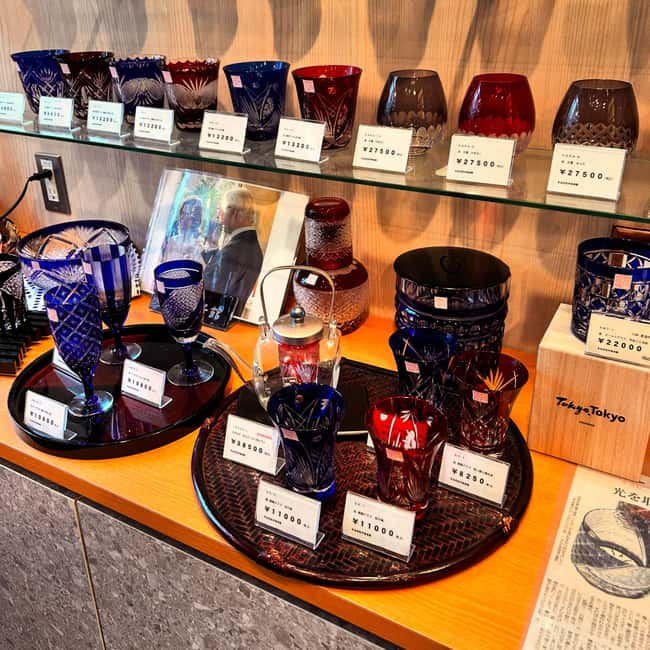
- A craft shop after the workshop: Browse classic designs and modern brand collaborations, including Starbucks items, but budget separately for any purchases.
At work in a Sumida glass studio
The workshop takes place in Sumida Ward, in a studio where craftsmen are actively cutting glass. That setting matters. Instead of seeing Edo Kiriko only as a finished object in a shop window, you get to watch the work that gives each piece its pattern.
The craft is often admired for its precise cuts and finished designs. Here, you see the process at close range before trying it yourself. Watching first gives you a clearer idea of the focus involved, and helps explain why a cut-glass piece can cost more than an ordinary drinking glass.
The session lasts 90 minutes, so expect an introduction and a hands-on activity rather than a long history lesson. The emphasis is on seeing the artisans at work, learning how to handle the tools, and making a piece you can take home.
English support is available, while the master artisan speaks Japanese. An English-speaking guide helps translate the explanations, making the workshop accessible even if you do not speak Japanese. No guide names are provided, so you should not expect a particular person to lead your session.
More hands-on workshops in Tokyo:
- Sushi Making Tokyo Roll and Authentic Japanese Sushi Class
★ 5.0 · 3,971 reviews - Tokyo: Roll and Authentic Sushi Making Class in Asakusa
★ 4.9 · 1,957 reviews - Tokyo Shinjuku Chopsticks Making Class
★ 5.0 · 1,763 reviews
Practice first, then make your cuts
Before choosing your glass, you get a short practice session with the tools. This is one of the most useful parts of the workshop, especially if you have never cut glass. The technique calls for dexterity and concentration, and a test piece gives you room to get used to the feel of the process before working on your own item.
A relaxed atmosphere helps beginners settle in. You are not expected to arrive with a design background, and you can experiment rather than worry about making every cut perfectly. Still, the work does demand attention. A little patience will serve you better than rushing to finish.
The balance between freedom and instruction is worth understanding. You have room to make your own choices, which suits people who enjoy trying things independently. If you prefer close, step-by-step supervision, you may want to ask for guidance as you work. The workshop has English support, but the artisan’s explanations are translated, so it may not feel like a one-to-one English craft lesson.
After the practice session, you choose a glass from the day’s available stock. Each piece is unique, and the selection changes daily. That makes choosing part of the experience, but it also means you cannot count on a specific color, shape, or style being available.
Choosing a project for your age group
Adults and middle school students make a drinking glass. Elementary school children cut a lidded container under adult supervision. This distinction is practical: the project is adjusted by age group rather than asking younger participants to complete the same piece as adults.
The stated minimum is fourth grade in elementary school, and children under 9 are listed as unsuitable. Since school grade and age do not always line up neatly, check the age requirement carefully when booking for a child. An adult must accompany children. Companions may observe, but they cannot take part in the cutting unless they have booked as participants.
This can work well for a family if the children meet the age guidance and enjoy careful, hands-on activities. It is less suitable for very young children or anyone who would rather watch than concentrate on a craft. Pets are not allowed.
Making a design you can call your own
Once you have selected your glass, you cut your own original design with staff guidance. The finished item is meant to be a personal piece, not a factory-made souvenir with a workshop label attached. You leave with the object you worked on, which gives the activity a tangible result beyond the time spent in the studio.
Do not expect a flawless piece made by an expert. The appeal is in trying the technique and seeing how a few deliberate cuts can change the look of the glass. If you enjoy learning through doing, that process is the point. If you mainly want a polished piece for your home, you can also browse the shop instead, though those purchases are not included.
The work calls for a steady hand and focus. The practice glasses are there for a reason: use that time to get comfortable, and do not feel you need to rush into a complicated design. A simpler pattern you enjoy making may be more satisfying than an ambitious one you struggle to complete.
More tours and experiences in Tokyo:
- Mt Fuji and Hakone 1-Day Bus Tour Return by Bullet Train
★ 5.0 · 26,383 reviews - 1-Day Tokyo Bus Tour
★ 5.0 · 14,250 reviews - Tokyo: teamLab Planets TOKYO Digital Art Museum Entry Ticket
★ 4.6 · 9,779 reviews - Mt Fuji & Hakone Cruise, Drum Show Bullet Train 1 Day from Tokyo
★ 4.0 · 7,413 reviews
The shop gives Edo Kiriko a modern side
After the cutting session, you can visit the on-site shop. It displays colorful Edo Kiriko pieces, from classic designs to collaborations with international brands such as Starbucks. That mix shows how a traditional craft can reach beyond formal or ceremonial settings and find a place in modern products.
The shop is not part of the workshop fee, so treat it as browsing time unless you have room in your budget for another purchase. It can be helpful to see finished examples after making your own piece. You may notice details in the shop that you did not spot before trying the tools yourself.
Photography is allowed in designated areas. Follow the studio’s guidance about where you may take pictures, particularly while artisans are working. An English-speaking guide may also help with photos, but the main value remains the chance to see and try the craft.
Is $122 a fair price for 90 minutes?
At $122 per person, this is not a low-cost activity. The price is easier to justify if you value the combination of a studio visit, a guided introduction, a practice session, and a handmade piece to take home. You are paying for access to a craft process, not simply admission to a display.
The finished item is an important part of the value. One participant described the process as a way to understand why Edo Kiriko pieces sell at a high price. That is a useful insight: once you have tried cutting glass, the time, care, and skill behind the finished work become easier to appreciate.
On the other hand, the price may feel steep if you are looking for a quick activity or a low-cost souvenir. Shop purchases are extra, and food, drinks, and hotel transfers are not included. There is no need to add those costs to make the workshop worthwhile, but they should be part of your planning if you intend to buy a piece from the shop.
The group size is capped at four participants, which adds value for anyone who wants a quieter setting and room to work. It does not guarantee constant individual instruction, though. The format leaves some freedom to experiment, and people who need close supervision may want to ask questions early rather than wait until they are midway through a design.
Who will enjoy this hands-on craft session?
This workshop suits you if you like making things, are curious about Japanese crafts, or want a memorable activity that is different from visiting another landmark. It can also be a good choice for a family with children who meet the age guidance and are comfortable focusing on a detailed task.
It is less suited to children under 9, people who want a fully guided step-by-step class, or anyone who prefers a short demonstration without hands-on work. The 90-minute session is indoors and wheelchair accessible, but the actual cutting activity requires using tools and concentrating on the design.
Solo participants and pairs can also find the small-group format appealing. With no more than four participants, the session does not depend on having a large group to create a lively atmosphere. You can focus on your own work and still see the artisan’s technique up close.
Should you book the Sumida workshop?
Book it if you want to do more than admire Edo Kiriko from behind glass. The chance to watch working artisans, practice with the tools, choose your own piece, and take home something you cut yourself makes this a memorable 90-minute stop in Tokyo.
Think twice if the $122 price feels high for a single craft activity, or if you expect close personal instruction at every step. The best fit is a curious, patient beginner who enjoys trying a new skill and accepts that a handmade first attempt may have its own character. Free cancellation is available up to 24 hours in advance, and you can reserve now and pay later.
FAQ
How long does the Edo Kiriko workshop last?
The workshop lasts 90 minutes, or 1.5 hours.
Where does the workshop take place?
It takes place in an Edo Kiriko glass studio in Sumida Ward, Tokyo.
What language is the workshop in?
The artisan speaks Japanese, and English-speaking support is provided. The listed live guide languages are Japanese and English.
What will I make during the workshop?
Adults and middle school students cut a drinking glass. Elementary school children make a lidded container with adult supervision.
What is the minimum age to join?
The stated minimum is fourth grade in elementary school, with an adult companion. Children under 9 are listed as unsuitable.
Can an accompanying adult observe without taking part?
Yes. Adults must accompany children, and companions may observe without cutting.
Is the workshop wheelchair accessible?
Yes, the activity is listed as wheelchair accessible.
Are shop purchases included in the price?
No. The workshop fee does not include purchases from the on-site shop.
Freshly reviewed in Tokyo
- Tokyo: Toshimaya Sake Brewery Tour with Sake Tasting★ 5.0 · 6 reviews
- :Tokyo,Shibuya /Meiji Shrine tour in KIMONO/English-friendly★ 5.0 · 4 reviews
- Tokyo: Tour Privado por Tokio en español★ 4.3 · 4 reviews
- Tokyo:Tea ceremony experience at Komaba Warakuan★ 4.8 · 9 reviews
- :Tokyo,Shibuya/ Pro Photography in Kimono / English-Friendly★ 5.0 · 26 reviews
- Tokyo:Samurai Training : Swords, Bushido & Mental Discipline★ 5.0 · 6 reviews
- Tokyo:Nikko UNESCO World Heritage Sites Private 1-Day Tour★ 3.8 · 6 reviews
- Tokyo:Mt Fuji & Hakone Day Tour with English Speaking Driver★ 5.0 · 26 reviews
Tokyo Tours, compared.

Mt Fuji and Hakone 1-Day Bus Tour Return by Bullet Train
Read our review →

teamLab Planets TOKYO Digital Art Museum Entry Ticket
Read our review →
Mt Fuji & Hakone Cruise, Drum Show Bullet Train 1 Day from Tokyo
Read our review →
Shinjuku Food Tour (13 Dishes at 4 Local Eateries)
Read our review →
Tokyo Mt Fuji 5th St & Hakone Cruise Bus Tour w/Bullet Train
Read our review →
Flagship 2-Hours Official Street Go-Kart Tour – Tokyo Bay Shop
Read our review →