Reviewed · TOKYO TOURS
Tokyo Self-Guided Audio Tour
Tokyo’s great trick is how quickly it changes character: imperial gardens give way to neon crossings, then to old temple streets and waterfront views. This self-guided audio tour links 22 major sights, letting you shape the day instead of keeping pace with a group.
I like two things here: you can choose which stops deserve your time, and the package pairs audio with a map, so you have both context and a way to find each listed attraction. The route spans very different sides of the city, from the Imperial Palace to Odaiba and Ueno.
The catch is scale. Twenty-two stops across Tokyo do not make a realistic four-hour outing, especially when transit and admission are on you. A few users also had trouble matching the commentary to their location or accessing help, so test both links before setting out.
- Twenty-two stops, one flexible route: Pick a few sights or spread the audio across several days.
- Two links do the work: One opens the audio on SoundCloud; the other shows the attractions on Google My Maps.
- The four-hour estimate needs context: The listed ten minutes per stop totals more than three and a half hours before travel.
- Entry and transport cost extra: Several gardens, museums, and observation spots charge admission, and no transfers are included.
- Access lasts up to six days: That makes a selective, multi-day approach more practical than racing around Tokyo.
- Seasonal planning is up to you: The audio does not include guidance on the best season for each stop.
A citywide sampler, not a four-hour march
At $9 per person, this is a low-cost way to add background to Tokyo’s best-known sights. You are buying audio access and a map, not a guide who meets you, a transit pass, or admission to attractions. The price can make sense if you like independent exploring and plan to use the material at several stops.
The stated duration is about four hours, but the route names 22 attractions and assigns ten minutes to each. That is 220 minutes before you account for walking, trains, meals, queues, or time inside museums and gardens. The stops also range from central Tokyo to Odaiba, Asakusa, and Ueno, so treating the full route as one compact walk would be a mistake.
I would approach it as a menu. Choose a cluster that suits your interests, then use the map to decide how to move between them. The audio access lasts up to six days, giving you room to split the sightseeing across different days rather than turning the city into a checklist.
From Tokyo Station to the Imperial Palace moat
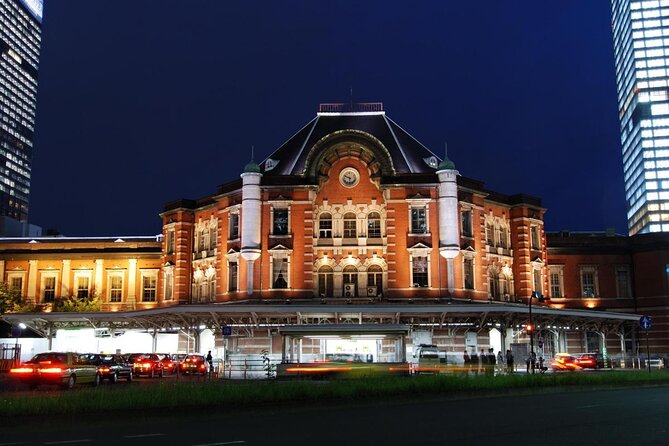
Tokyo Central Railway Station is a fitting place to begin. It is both a working rail hub and a landmark tied to Japan’s modernization, so the audio can help you look beyond the rush of commuters and notice the station’s architectural importance. The visit is listed as ten minutes, which is enough for an introduction, not an exhaustive look.
From there, the East Gardens of the Imperial Palace take you into the former grounds of Edo Castle. The appeal is the contrast: carefully kept gardens and castle remains sit in the middle of modern Tokyo, with imperial history beneath the calm surface. Admission is listed as free, but allow more time if you want to walk the grounds rather than simply hear the introduction.
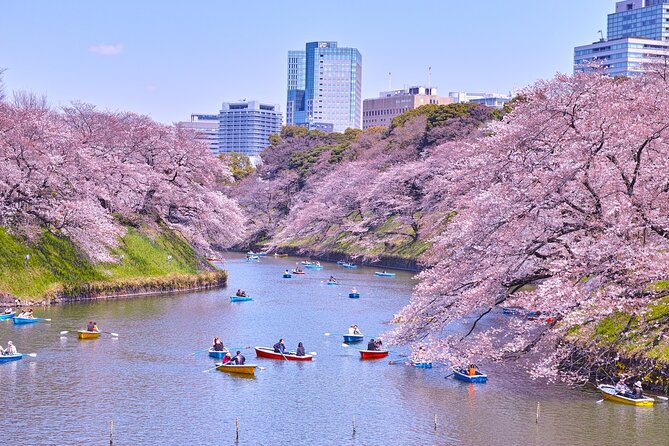
Chidorigafuchi, a moat known for spring cherry blossoms, adds a landscape shaped by the city’s old defenses. Its seasonal appeal matters. In blossom season, it may deserve a slower visit; outside that period, the audio’s historical context may be the main reason to stop. Admission is not included, so check costs before you go.
Yasukuni Shrine follows with a subject that calls for care. It is dedicated to Japan’s war dead and has a complex, controversial place in public life. The tour promises historical and cultural context, but an audio stop cannot settle every debate. Listen with an open mind, and leave room to think rather than treating the shrine as a simple photo stop.
These four locations make a coherent central-Tokyo group, though you will still need to plan the links between them. The app’s map can help with the order, but it does not provide transport.
More self-guided tours in Tokyo:
- Tokyo: Open Top Panoramic Sightseeing Bus with Audio Guide
★ 3.8 · 254 reviews - Tokyo: 60min Panoramic Open Top Bus Tour with Audio Guide
★ 4.0 · 40 reviews - Akihabara: Self-Guided Tour with a special brochure
★ 3.7 · 11 reviews
Shinjuku’s gardens, government towers, and Meiji Shrine
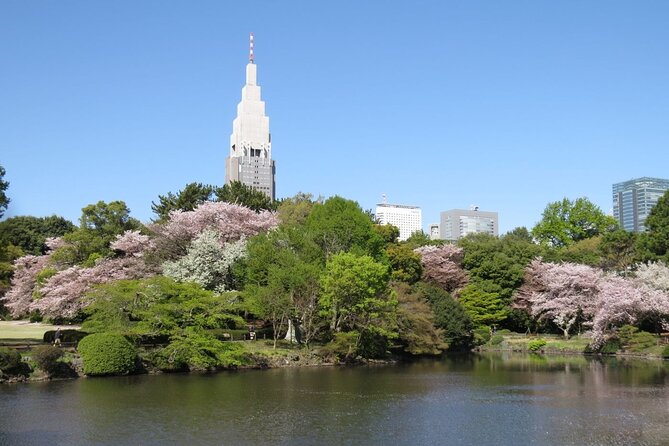
Shinjuku Gyoen offers a different kind of pause. Its Japanese, French, and English garden styles reflect changing tastes, while its imperial beginnings and postwar transformation give the grounds a longer story. Admission is not included. If gardens are a priority, do not squeeze this into a ten-minute stop just to keep to the stated duration.
The Tokyo Metropolitan Government Buildings provide a free change of pace. The audio introduces the buildings’ modern architecture and Tokyo’s governance, while the observation areas offer panoramic city views. This is one of the more practical value stops: you can get a sense of the city’s scale without paying an entry fee, though the tour does not specify how long you should allow for the visit.
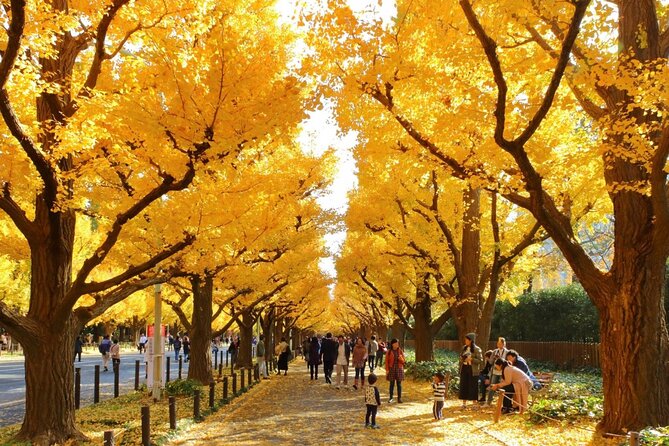
Meiji Jingu Shrine brings you into a forested setting dedicated to Emperor Meiji and Empress Shoken. Its Shinto traditions and imperial links make it a useful counterpoint to Tokyo’s dense commercial districts. Admission is listed as free. Give yourself time to walk through the grounds; the ten-minute estimate is best understood as audio time, not a full shrine visit.
The west-side stops work well together if you are drawn to gardens, public architecture, and religious sites. I would avoid pairing all of them with the far eastern museums on the same tightly timed outing. Tokyo rewards a slower pace, and the stops are more meaningful when you have time to notice the setting around you.
Shibuya, Roppongi, and the city’s modern face
Shibuya Crossing is famous for its waves of pedestrians, but the audio aims to give the district a longer arc, from residential area to fashion center. The attraction itself is free and easy to see, but the useful part of the stop is the context. It can help turn a quick look at the crossing into a better sense of how the neighborhood changed.
The National Art Center, Tokyo, is described as an empty museum because it hosts changing exhibitions rather than maintaining a permanent collection. Its design and role in Tokyo’s cultural life are the focus here. Entry to the building is listed as free, but exhibitions may have their own fees, so check what is showing if you want to go inside.
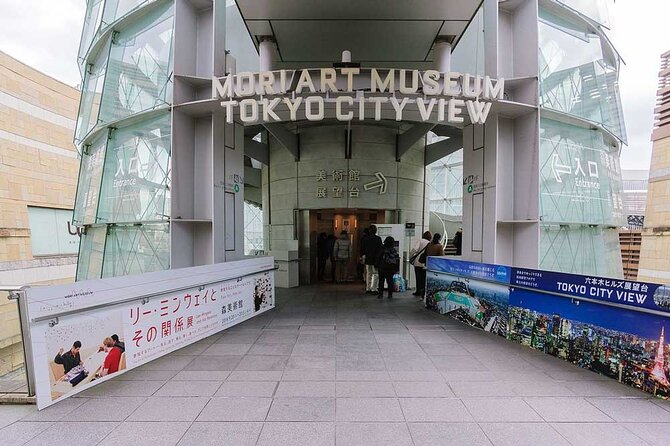
Mori Art Museum offers a different art experience, high above Roppongi Hills. The tour points to its contemporary art and city views. Admission is not included, and this is a stop where you should decide in advance whether the exhibitions are worth the extra cost for you. The audio provides context, but it does not replace time in the galleries.
These three stops make a useful modern-Tokyo cluster, though they have different rhythms. Shibuya is about street life; the two museums call for more deliberate time and, potentially, paid entry. If you are watching your budget, you can still use the free public-space stops and leave the museum visits for another day.
Tokyo Tower, Zojoji, and the bay
Tokyo Tower recalls postwar Japan, with its design inspired by the Eiffel Tower and its place in the city’s modern identity. The audio covers its construction and significance. Admission is not included, so you can admire the structure from outside without paying, or budget extra if you want the tower experience itself.
Zojoji Temple sits near Tokyo Tower, making the contrast between Buddhist tradition and modern landmark especially clear. Its connection to the Tokugawa shogunate adds a historical layer, and the temple grounds are listed as free. This pairing is one of the route’s more satisfying juxtapositions: you get two very different versions of Tokyo within the same area.
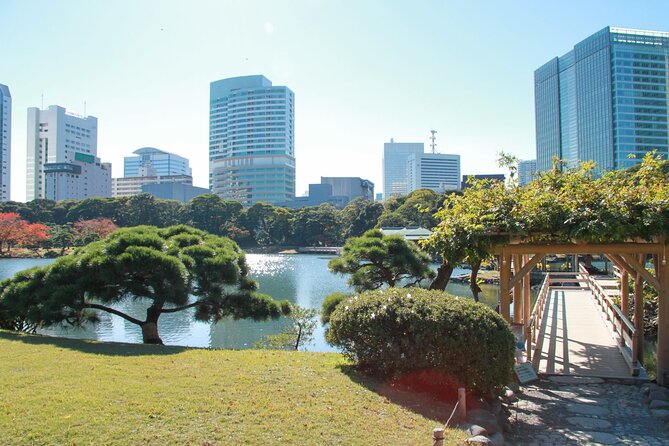
Hama Rikyu Gardens carry the story toward the waterfront. Once a feudal lord’s residence, the gardens have adapted as the city changed around them. Admission is not included. Allow enough time to enjoy the grounds, particularly if you have already spent the day moving between major sights.
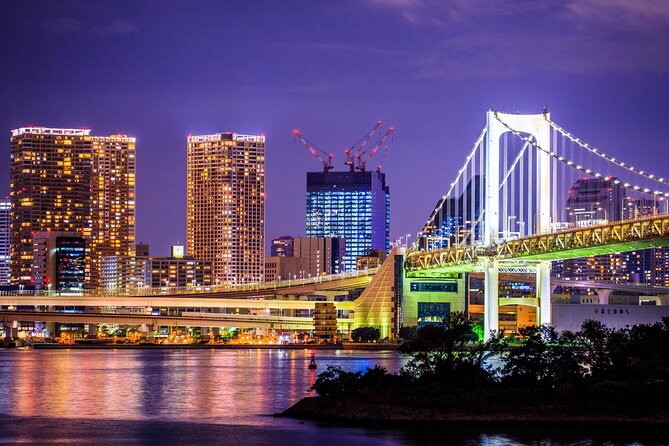
Rainbow Bridge and Odaiba shift the mood again. The bridge spans Tokyo Bay and is illuminated at night, while Odaiba grew from an artificial-island development into a leisure district. The bridge is listed as free to see; Odaiba attractions may charge entry. Since transport is not included, plan how you will reach and leave this waterfront area before you set off.
This section can be an outing of its own. The mix of temple, garden, tower, bridge, and artificial-island district is too broad to appreciate as a quick chain of ten-minute visits.
More audio-guided visits in Tokyo:
- Tokyo: Sumo Keiko Training Tour with Audio Guide & Photo
★ 4.8 · 5 reviews
Asakusa and Ueno, old Tokyo and its museums
Tokyo Skytree is a modern landmark whose design draws on traditional Japanese aesthetics. The audio explains the design, while the tower itself gives you a reason to look upward and consider Tokyo’s newer skyline. Admission is not included, and you should treat going up the tower as a separate paid choice rather than part of the $9 price.
Nearby, Senso-ji is Tokyo’s oldest temple, with a founding legend and an important place in Edo-period life. The temple is listed as free to visit. Asakusa, the surrounding historic district, adds the broader story of an entertainment area that became a cultural center. Together, these stops offer more than a temple photo: they give you a feel for the neighborhood’s older identity.
Ueno Park is a sensible place to finish, especially if you want to combine open space with museums. It is a popular public park with its own history and a major role during cherry-blossom season. The park is free, though the museums within it charge admission.
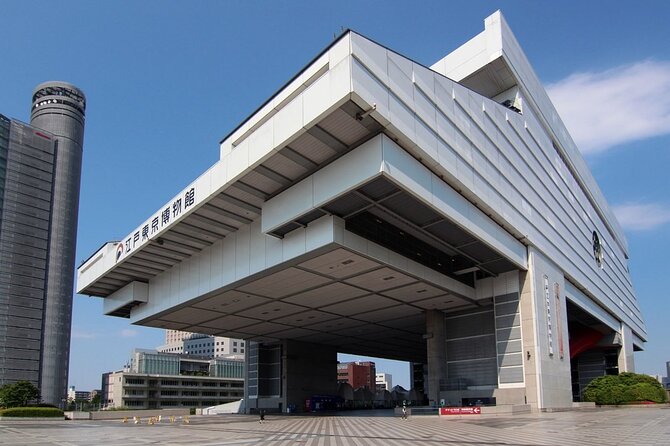
Three museums are included in the audio route. The Tokyo National Museum focuses on Japanese art and antiquities and is Japan’s oldest and largest museum. The National Museum of Nature and Science covers the natural world and technological progress. The National Museum of Western Art is housed in a Le Corbusier-designed building and has UNESCO World Heritage status. Entry fees are not included for these museums.
You could spend much of a day in Ueno alone. Pick the museum that best matches your interests instead of trying to see all three, then leave time for the park and Asakusa. The tour gives you a framework, not a substitute for choosing what matters most to you.
The links, the limitations, and the real value
Before travel, you receive two links by email on your selected date. The first opens the audio through SoundCloud, with options to listen to individual attractions or the full set. The second opens a Google My Maps page, where each marked stop links to its audio guide. You can review the material in advance and plan a route around your priorities.
There is an important practical wrinkle: the tour is described as usable without being online, but the access instructions rely on web links. The details do not explain whether audio can be downloaded for offline use. I would open both links before leaving, test them, and clarify offline access with the provider if you expect to have no connection.
The format also depends on you matching the audio to your location. Some users have found that the commentary did not always line up with where they were, and others reported difficulty getting a response when they needed help. The map-and-audio setup is straightforward in principle, but it is not a live guide following your position. Check the map carefully before pressing play.
The strongest positive note is that the experience can be simple and flexible when the links work as intended. One suggestion for improving it is seasonal advice: cherry blossoms at Chidorigafuchi and Ueno, and autumn color in gardens, can change what deserves priority. You will need to make those timing decisions yourself.
At $9, the value is reasonable if you want background for a handful of sights and are comfortable planning your own route. It is less compelling if you expect transportation, admission, live guidance, precise location-triggered narration, or a ready-made four-hour route. Those are not part of the package.
Should you book this Tokyo audio tour?
Book it if you enjoy independent sightseeing, want a low-cost introduction to several parts of Tokyo, and are willing to use the map and choose your own pace. It is particularly suited to someone who wants short historical context at selected landmarks and does not need a guide to manage the day.
Skip it if you want a tightly coordinated route, included transport, or someone on hand to lead you between stops. The 22 attractions are too spread out for a true four-hour sweep, and the audio may not always match your exact location. For the best chance of a worthwhile day, test the links first, choose one or two nearby clusters, and treat the six-day access window as a useful planning tool.
FAQ
How much does the Tokyo Self-Guided Audio Tour cost?
It costs $9 per person. Entry fees and transportation are not included.
How long is the tour?
The approximate duration is four hours, but the route covers 22 attractions. Each stop is listed as ten minutes, before you account for travel or time inside paid attractions.
Can I choose where the tour starts and ends?
Yes. You decide your own starting point and ending point, and can choose which stops to visit.
How do I access the audio and map?
You receive two links by email on your selected date. One opens the audio guides through SoundCloud, and the other opens an interactive Google My Maps page.
How long are the access links valid?
The private access links are valid for up to six days.
Is transportation included?
No. Transportation, including pickup and drop-off, is not included.
Are attraction entry fees included?
No. The tour price does not cover entry fees where required. Several gardens, museums, and towers on the route have admission costs.
Can I use the audio without being online?
The tour is described as usable without being online, but the access instructions provide web links and do not explain whether audio can be downloaded. Check that point before relying on offline access.
Is this a group tour?
No. It is a private self-guided activity, so only your own group participates.
Freshly reviewed in Tokyo
- Tokyo: Toshimaya Sake Brewery Tour with Sake Tasting★ 5.0 · 6 reviews
- :Tokyo,Shibuya /Meiji Shrine tour in KIMONO/English-friendly★ 5.0 · 4 reviews
- Tokyo: Tour Privado por Tokio en español★ 4.3 · 4 reviews
- Tokyo:Tea ceremony experience at Komaba Warakuan★ 4.8 · 9 reviews
- :Tokyo,Shibuya/ Pro Photography in Kimono / English-Friendly★ 5.0 · 26 reviews
- Tokyo:Samurai Training : Swords, Bushido & Mental Discipline★ 5.0 · 6 reviews
- Tokyo:Mt Fuji & Hakone Day Tour with English Speaking Driver★ 5.0 · 26 reviews
- Tokyo:Nikko UNESCO World Heritage Sites Private 1-Day Tour★ 3.8 · 6 reviews
Tokyo Tours, compared.
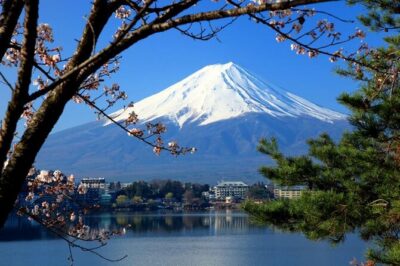
Mt Fuji and Hakone 1-Day Bus Tour Return by Bullet Train
Read our review →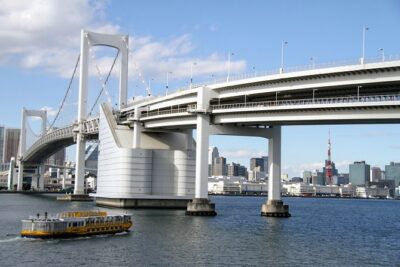
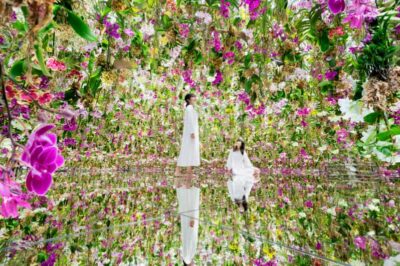
teamLab Planets TOKYO Digital Art Museum Entry Ticket
Read our review →
Mt Fuji & Hakone Cruise, Drum Show Bullet Train 1 Day from Tokyo
Read our review →
Shinjuku Food Tour (13 Dishes at 4 Local Eateries)
Read our review →
Tokyo Mt Fuji 5th St & Hakone Cruise Bus Tour w/Bullet Train
Read our review →
Flagship 2-Hours Official Street Go-Kart Tour – Tokyo Bay Shop
Read our review →